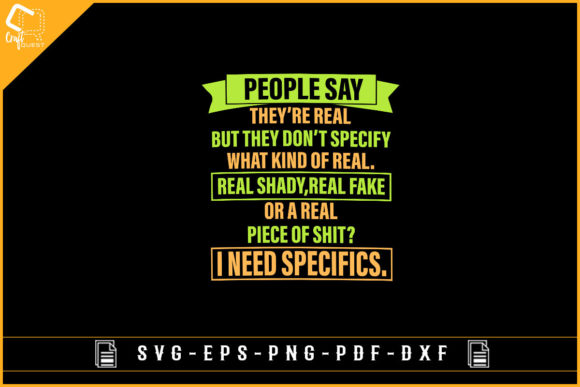
People Say They Re Real but They Don t Specify
I have spent years reviewing digital assets for the embroidery community, sifting through thousands of files to find those that actually hold up under a needle. Most designs are forgettable, but People Say They re Real but They Don t Specify caught my attention immediately. It is not just another generic quote; it carries a specific, biting attitude that feels perfect for modern streetwear and boutique branding. As an experienced designer, I do not simply look at the vector lines; I visualize the finished product on fabric, the way the thread catches the light, and how a customer will react when they read the message.
The phrase itself is a conversation starter. It taps into a universal frustration with vague compliments or empty promises. When you place this design on a tote bag, a sweatshirt, or a kitchen towel, it does more than decorate; it communicates personality. The layout suggests a bold statement piece rather than a subtle accent. In my experience, designs with this level of attitude perform best when paired with clean backgrounds where the text can breathe. It creates an immediate mood of wit and realism that appeals to buyers who appreciate honesty in their handmade goods.
Real-World Application: From Digital File to Finished Product
Let me walk you through a scenario I recently considered while planning a holiday collection for a small Etsy shop. Imagine preparing a custom embroidered tote bag for a client who loves dry humor. You pull out the People Say They re Real but They Don t Specify file, which comes in SVG, EPS, DXF, PNG, and PDF formats. This versatility is crucial because it allows you to adapt the design whether you are stitching it directly onto a canvas tote or using the PNG as a printable mockup for your online listing.
When I ran a simulation on a thick cotton canvas, the design felt right at home. The length of the text works beautifully across the front of a standard tote, creating a balanced visual weight. However, if I were to attempt this on a baby onesie, I would hesitate. The sentiment is mature and slightly cynical, which might clash with the soft, innocent aesthetic usually desired for infant apparel. Similarly, placing this on a delicate pillow cover requires careful consideration of the thread colors. A high-contrast black thread on white fabric would make the words pop aggressively, whereas a pastel thread might soften the blow too much, losing the intended impact.
The design also shines in commercial embroidery projects for branded merchandise. Think of a craft business owner selling aprons at a local farmers market. An apron featuring this quote adds a layer of relatability that customers love. It transforms a simple utility item into a statement accessory. The same logic applies to holiday gifts. A sweater embroidered with this line makes for a memorable present for someone who appreciates sarcasm, moving beyond the typical "Happy Holidays" clichés that clutter the market.
Navigating Technical Challenges in Stitching
While the concept is strong, the execution requires technical precision. Not every machine embroidery design handles complex lettering well. If the font used in People Say They re Real but They Don t Specify features thin serifs or intricate curves, you must be wary of using it on stretchy fabrics like jersey or lightweight polyester. These materials often distort during stitching, causing the letters to wobble or the text to become unreadable.
For textured fabrics, such as fleece or heavy wool, the design needs enough fill stitch density to anchor itself securely. If the stitch count is too low, the texture of the fabric might peek through the threads, ruining the clarity of the message. Conversely, on smooth fabrics like satin or silk, the design should be treated with care regarding stabilizer choice. Using the wrong backing can lead to puckering, which distorts the spacing between the words and undermines the professional look of the finished product.
Another critical factor is the hoop size. If the design is intended for a small 4x4 inch hoop, you must verify that the lettering does not get cut off or compressed. Tiny lettering on curved surfaces, such as caps or beanies, is a recipe for disaster unless the digitization was specifically optimized for that curve. Since the description mentions the design is ready to print and use, I recommend checking the specific dimensions provided by the creator before committing to a production run. If the file lacks detailed instructions on stitch density or recommended thread types, test it on scrap fabric first to ensure the tension holds up.
Visual Appeal and Customer Perception
In the world of handmade products, trust is everything. A sloppy stitch job can destroy a brand's reputation instantly. When People Say They re Real but They Don t Specify is executed correctly, it elevates the perceived value of the item. The sharpness of the satin stitch along the edges of the letters conveys quality, while the consistency of the fill stitch demonstrates attention to detail. Customers scanning an Etsy listing are drawn to items that look professionally made, and this design has the potential to deliver that premium feel.
The visual personality of the design also aids in brand consistency. For a creative entrepreneur building a shop focused on witty, no-nonsense aesthetics, this asset fits seamlessly into a cohesive collection. It reinforces a brand identity that values authenticity over fluff. Whether you are selling personalized gifts or commercial embroidery services, having a design that resonates emotionally with the buyer increases engagement and conversion rates.
However, there are scenarios where this design should be avoided. Small decorative accents, such as a tiny logo on a shirt pocket, might lose the nuance of the long sentence. The message relies on the reader taking a moment to process the full text, which is difficult when the design is reduced to a mere speck. Additionally, on dark fabrics, the contrast becomes a major hurdle. If the thread color does not stand out sharply against the background, the design loses its punch and may appear muddy or indistinct after washing.
Practical Notes for the Embroidery Designer
Before you start stitching, remember that preparation is key. Review the stitch density carefully; overly dense areas can cause the fabric to pucker, especially on lightweight materials. Ensure you have the correct stabilizer for your project type—cut-away for stability on garments, tear-away for lighter projects. Always inspect small details under magnification to catch any loose threads or alignment issues before the final product goes out the door.
If you plan to sell finished items featuring this design, confirm the licensing terms explicitly. Some digital files allow for personal use only, while others permit commercial sales of the physical goods. Understanding these distinctions protects your small business from legal complications. Furthermore, compare the design in both black and white mockups to ensure the hierarchy of the text remains clear regardless of the thread color palette you choose.
Ultimately, People Say They re Real but They Don t Specify is a powerful tool for designers looking to add edge and emotion to their craft business. It bridges the gap between a simple graphic and a meaningful textile art piece. By understanding its strengths and limitations, you can create finished products that not only look great but also tell a story. Whether it ends up on a sweatshirt, a patch, or a holiday gift, the success of the project lies in your ability to translate the digital file into a tangible, high-quality reality.